Walk This Way
6 min readSignage and wayfinding have been a growing part of our practice for some time. As the scale, location and complexity of projects expand, we have developed some principles that help us deliver wayfinding systems as a spatial expression of brand + culture.
How we arrived here
Our first signage commissions were relatively focused: sign families, mapping systems, icon sets. Early clients included Dublin City Council, Fota Wildlife Park, and Science Gallery. Purposeful work that taught us a lot, and work that made clear, early on, that this discipline deserved to sit at the heart of a project, not at its edges.
What changed us was scale and complexity. As projects grew, it became clear that successful signage cannot be delivered from a purely graphic design perspective. You need to understand architecture, information design, product design, engineering, accessibility, sustainability, and most importantly, people. How they move. How they think. How they feel in a space. That realisation shaped the practice we have today. We partner with clients across Ireland and into Europe, including Dublin Airport Authority, Grant Thornton, IADT, Stripe and Salesforce. What we bring to each one is not simply a set of well-crafted specifications but an overarching strategy that communicates, directs, and helps build a genuine sense of place.
What we have learned along the way
Strategy first.
Signage is, remarkably often, treated as a late addition to a project: something sorted near the end, after the decisions that shape how a space looks and feels have already been locked in. In our experience, this is one of the most costly assumptions a project team can make.
The best results have always come when we were part of the conversation from the beginning. Starting early means we can do much more than match a brief. Our background in brand development allows us to build systems that go beyond following a style guide. When approached strategically, signage can deepen brand experience and actively build a sense of place. Combine that with close collaboration with space planners and interior architects, and the result is a system where form and function feel genuinely inseparable.
We use dedicated signage management software at every stage of a project, from initial audit and planning, through design, fabrication, and installation, to the long-term management and maintenance of a completed system. For clients, that means a single, accurate record of their signage throughout its lifecycle, one that remains useful long after the project has been delivered.
User first.
Wayfinding UX has a lot in common with good digital design. We develop audience personas and map visitor journeys. We identify the routes that matter most, establish where people will need to make decisions, and determine what they need to know at each of these points. All of this happens before any visual design begins.
Wayshowing.
Wayfinding is what people do: the process of navigating a space. The term wayshowing (introduced by Danish designer Per Mollerup) describes what designers do, deliberately shaping the cues that help people find their way. It is a useful distinction because it opens the conversation well beyond traditional sign types.
Architectural features, lighting, landscaping, and environmental graphics all contribute to how people orient themselves. When these are considered together from the outset, the number of physical signs often reduces. The goal is not signage that disappears, but signage that belongs: intentional, appropriately functional, and integrated into the fabric of its context. When it is working well, it feels like it could not have been any other way.
Brand building.
There is a version of signage that ticks the compliance boxes, correct typeface, correct colour, correct logo, and does nothing more. That version misses the point entirely.
The most effective systems treat brand integration not as rules to follow, but as values to express. Materiality, tone, finish, and personality all carry meaning. When these are handled with care, signage stops being infrastructure and becomes part of what makes a place feel like itself.
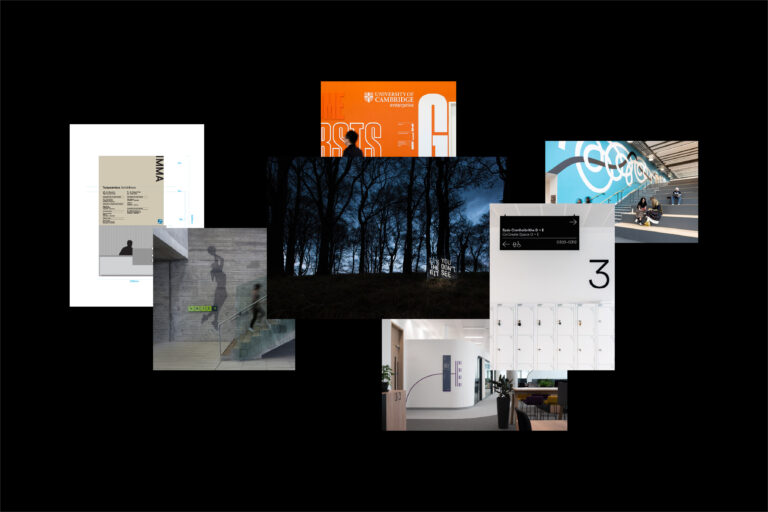
Our recent work on the IADT Digital Media Building is a good example, a system designed to support navigation while also amplifying the creative culture at the heart of what IADT does. Brand and wayfinding working as one.
Universal design.
Inclusive design is not an add-on. It has to be built into the strategy from the start.
In practice, this means careful attention to typeface selection, type size and weight, colour and contrast, surface reflectance, sign positioning, consistency across a scheme, language, and the integration of braille and tactile elements. The regulatory landscape varies by location and building type, and it changes over time. In Ireland, we work across a range of standards produced by different bodies, with requirements that vary by use and level of public access. As our work has expanded across Europe, with recent projects in Amsterdam, Berlin, London, Madrid, Paris, and Stockholm, we have built a network of local compliance specialists to make sure every project meets its requirements wherever it lands.
Worth noting: when working with international brands, regulatory standards can vary wildly. What is deemed best practice under ADA in the US can be the complete opposite of ISO, EN, or BS standards across EMEA, where local codes and directives add further complexity. Ironically, most accessibility standards are not readily accessible. They need to be purchased and kept up to date through the bodies that produce them, an unnecessary overhead for studios simply trying to do the right thing.
Materials matter.
Sustainability runs through every material decision we make. Many of the projects we work on are targeting LEED certification, and the range of good specification options has grown considerably in recent years. Bio vinyls, acrylic alternatives made from paper laminates and synthetic resin, and a return to paper-based wall coverings are all low-carbon options capable of delivering a premium finish.
Longevity matters just as much as the carbon emissions at the point of manufacture. Choosing more durable or premium materials, even where the upfront cost is higher, reduces the frequency of maintenance and replacement over time. A considered specification that avoids cheap plastics and accounts for a system’s full lifecycle is almost always the more responsible choice, and usually the more cost-effective in the long term.
Great signage is rarely the thing people talk about when they leave a space. But it shapes how a visit feels from start to finish: how confident people feel, how they connect with a place, how clearly an organisation’s character comes through in the physical world. When it works, it becomes simply part of what the place is. That is the standard we work to on every project.
In our next piece, we look at Environmental Graphic Design, where wayfinding meets storytelling and spaces take on a life of their own. If you are working on a project that involves signage or wayfinding, we would love to discuss it.